Contribute a methodology
Do you own or work on a method* that helps people estimate the environmental impacts from their digital tech? If so, we would like to include you in the DIST methodology map.
* Think of a method as a broad term covering a range of approaches such as calculation procedures, formulas, datasets, estimation tools and resources - anything that helps you produce numbers for a taxonomy category.
Why should I submit my method?
In general, DIST is aimed at making it easier for organisations who want to understand and report on their digital technology environmental impacts. One of the things we frequently hear from first timers is the field of digital sustainability reporting is a minefield to navigate - it’s not clear what’s out there, what the scope of methods are (see DIST taxonomy), how to standardise data and importantly what can be trusted. The DIST methodology map is seeking to make this a whole lot easier.
There’s several advantages to your method being included:
- Your approach will get more visibility amongst potential users.
- We summarise key information about your method, so others can compare and constrast easily.
- We work with you to keep your information accurate, so it can be trusted.
- It’s free to be included.
When should I submit?
You can submit at any time. This is continually open process for community contributions.
How do I submit my method?
We estimate a submission will take you about 15 minutes. You can submit via two routes:
1. Submit via GitHub
Submit a method using the GitHub template which is prefilled with all required contribution fields.
2. Submit via email
If you cannot use GitHub, please contact the Green Web Foundating using the online support form.
Do you accept submissions on behalf of others?
Sorry, but we don’t. If you are working with methods you think should be included in the map, but aren’t directly involved, the most helpful thing you can do is get in contact with the method owner and ask them to submit it to us themselves. We want to ensure what’s listed in the map is maintained over time, and our experience stewarding the Green Web Dataset has taught us that in order to do that we need to be in direct contact with those owning the things we list.
How do I know if my method is suitable?
The word “method” is best thought of as a broad term covering a range of approaches such as calculation procedures, formulas, datasets, estimation tools and resources - anything that guides someone to produce numbers aligned to one or more taxonomy categories. If your method is designed to do that, you’re off to a good start!
Aditionally, for your method to be considered for inclusion in the DIST Methodologies Map, it must be:
- Relevant to an existing DIST impact dimension.
- Relevant to at least one existing DIST taxonomy sub-category. Multiple sub-categories across different parts of the lifecycle are accepted.
- Producing outputs in a single, standard measurement unit eg CO2eg, kWH etc.
- A complete submission - information for all of the fields marked as required in the “Methodology fields” table below are included when you submit.
- Available through an online, accessible URL - we accept closed source methodologies, but you must have at least a marketing page.
Further to these guidelines, all submissions should also meet the project’s general contribution guidelines as outlined in CONTRIBUTING.md.
Note: If you have a suggestion about how we can improve this contribution process and guidelines, please create an issue in the DIST GitHub repository.
What happens after I submit?
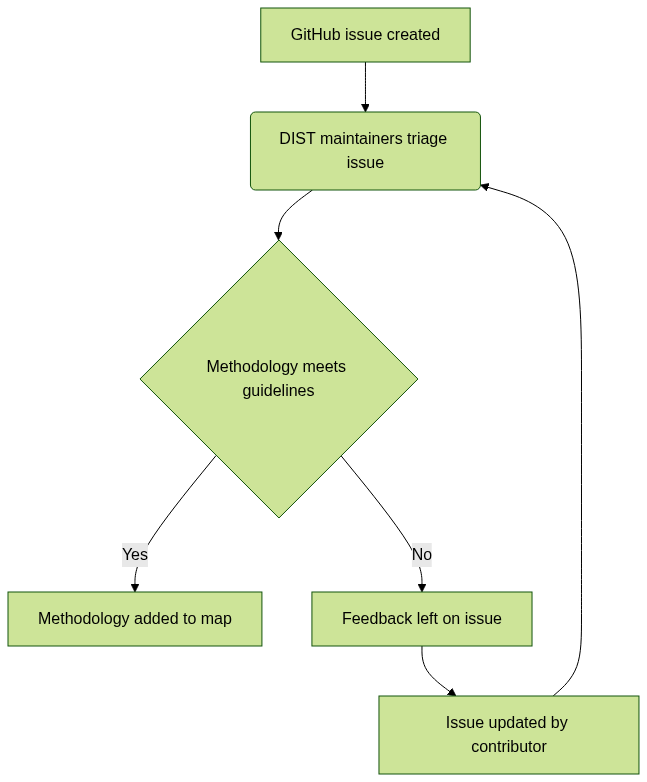
The process for including a method in the DIST Methodologies Map is outlined below in text and visual formats.
- A GitHub issue is created using the provided template.
- A DIST maintainer will review the issue to ensure that it meets the submission and contribution guidelines. You can expect this to happen within seven days of your submission, maybe sooner if we can.
- Meets guidelines: A DIST maintainer will add the methodology to the DIST Methodologies Map
- Does not meet guidelines: A DIST maintainer will leave feedback in the GitHub issue. The contributor can act on that feedback to prompt another review of the submission.